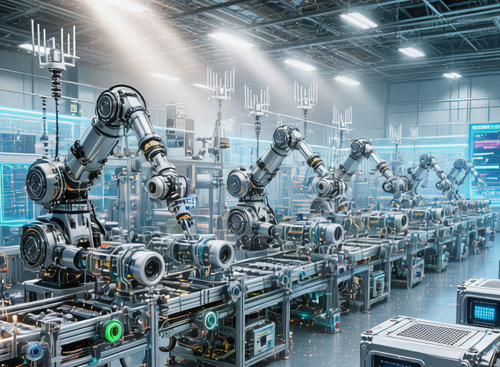
Revolutionizing Industrial Efficiency: Next-Gen Automation Sensors Reshape ManufacturingThe automation sensor landscape is undergoing a seismic shift as cutting-edge technologies unlock unprecedented levels of precision, intelligence, and operational efficiency across industrial environments. Four transformative innovations are leading this charge:1. AI-Powered Vision Sensors with Edge IntelligenceModern vision systems now integrate deep learning directly into compact sensors, enabling real-time defect detection without cloud dependency. Companies like Keyence and Cognex deploy on-device neural networks that identify microscopic surface anomalies at 0.05mm resolution while operating at 200% faster processing speeds than previous generations. Automotive manufacturers report 40% reduction in quality escapes using these self-learning sensors.2. MEMS-Based Condition Monitoring SensorsVibration analysis enters the Industry 4.0 era with millimeter-scale MEMS sensors that continuously track equipment health. Rockwell Automation's latest wireless tri-axial accelerometers sample at 20kHz, detecting bearing wear months before failure. Integrated with PLCs, these sensors autonomously trigger maintenance workflows when anomalies exceed ISO 10816-3 vibration thresholds.3. Multi-Parameter Environmental SentinelsHoneywell's new X-series gas detectors exemplify the convergence of sensing technologies. A single ruggedized unit now monitors O₂, H₂S, CO, LEL, and particulates while operating in -40°C to 75°C environments. Cloud-connected via ISA-100 wireless, these devices generate predictive exposure risk maps for refinery and pharmaceutical applications.4. Self-Organizing Wireless Mesh NetworksThe emergence of IWLAN (Industrial Wireless LAN) protocols enables sensor constellations with 99.999% data reliability. Phoenix Contact's FL WLAN 5100 series forms autonomous mesh networks where each sensor acts as a signal repeater, eliminating dead zones in complex facilities while maintaining <5ms latency for critical safety interlocks.Convergence with Industrial IoTThese advancements share a common trajectory: tighter integration with control systems through OPC UA over TSN (Time-Sensitive Networking). Siemens' SIRIUS ACT sensors demonstrate this evolution, embedding IO-Link interfaces that transmit device health data alongside process variables to PLCs, enabling predictive calibration and reducing commissioning time by 70%.The Road AheadAs sensor fusion algorithms mature, expect hybrid systems combining spectral analysis, thermal imaging, and quantum-based measurements. With cybersecurity now built into hardware like Pepperl+Fuchs' IS+ certified sensors, these technologies form the bedrock of resilient, self-optimizing smart factories.